Showing posts with label conservation. Show all posts

Thursday, July 30, 2015

Monk Seals!!!

Yesterday I began my volunteer program--those who know me, know I can't go to any wild place and not do some sort of conservation!  Here on O'ahu, I am working with the Monk Seal Foundation.  The sad fact of the matter is that Monk Seals are one of the most endangered species in the world, their numbers hovering around 1100 right now. 


Just waking up after a nap.  Mom is large and silver, and the pup, Holokai is dark.
 With dwindling habitat, infectious diseases, entanglements in fishing nets, ingesting fish hooks, and injuries from boats, their numbers are decreasing by 4% a year!  Unfortunately, with so many species in danger on the islands, and so much space to cover, the regulation of endangered species is minimal.  Thankfully, generous volunteers, like those with the Monk Seal Foundation, are trying to do their part to help.  They have a good number of local people who work regular shifts monitoring the seals, and the occasional "voluntourist" like me who help out.  Hopefully other similar non-profits will take hold to protect the other species here.

My work with the foundation actually began the first day I was on the island.  Irene and I drove up to the north shore, to Turtle Bay Resort, where a large section of coastline is monitored for seals.  There, the volunteer coordinator, Dana, gave an orientation presentation to all new volunteers, giving us factual information about the Monk Seals, threats to the population, and an explanation of our volunteer responsibilities.  
Dana orients all of us new volunteers on the Monk Seal Foundation's mission.
After a thorough introduction, Irene and I went about the rest of our trip, but I returned and had my first official day volunteering yesterday.  Most of what we do is try to educate passers-by.  People are usually so excited to see the seals that they go too close, or even try interacting with them.  We try to help people understand why we ask them to stay away, and just generally raise awareness about this critically endangered species.

As often as possible we also try to engage with local fishermen.  Even giving out free
barbless hooks to try to minimize the number of hooking incidents for local seals.
Educating tourists running on the beach.
 Another part of our work is in documenting behavior.  There is a mother and pup who are being watched carefully to assure that the mother and pup are healthy and developing as they should.
Writing notes about nursing and napping schedules.  Much like any new mom!
This is La'akea.  She is actually the pup's auntie!
This is Uma'lea and her pup Holokai (who only just got his name on Monday).

Here is Umalea and her pup Holokai in their cove.

The exciting part of this, is that the foundation watched Uma'lea grow up!  Her mom, Honey GIrl, has had 10 girls on this same coastline.  Now Uma'lea has turned five, and is herself having her first pup in the same cover where she herself was born!  It's wonderful to watch them (from 150' back).  Uma'lea is an incredibly sweet and affectionate mother.  More than any other seal mom they have seen, she is outwardly affectionate with the pup, as seen here putting her flipper around him, pulling him to her and snuggling.
Mom is often seen with her flipper around her pup.
A behavior unique to this first-time mother.
I was very lucky to witness Holokai's first venture out into open water.  Up until now, mom has been caring for him in a protected cove, the same cove where she was born!  Moms stay with their pups for only about 7 weeks, and he is 4 weeks old, so the next few weeks are devoted to teaching him how to find his own food and to survive on his own.  Yesterday's lesson was getting in and out of the rock shelf, swimming in open water for the first time.  The pup was apprehensive, and mom had to bark at him a lot, but eventually they made two trips.   They didn't go far or stay too long, but he did well for his first day.
Mom is teaching her pup to go out into the open water for the first time, leaving the security of the
 pool where he has been raised.  Here she is encouraging him across the rock shelf out into the sea.
Mom is calling the pup to come out, but he's not eager.
The pup's first venture out into open water!  
The pup needed a rest afterwards.  All the exertion and excitement really took a lot out of him!
 But look at how satisfied mom looks!
More snuggling
  Once the excitement of open water was done, and the pup had rested and nursed, now he was feeling fiesty!  He yelped, snapped, nipped, and wiggled, trying to get mom to play with him.  She even nipped him back a few times!  It was great fun to watch!

Pup playing with mom: yelping, nipping, poking at her.
Once my shift was over, I made my way back to the hostel, tired from the sun and the 15 mile round trip on my bike.  I was looking forward to getting in the water and relaxing by the sea.  But of course, no sooner had I gotten to the beach, than I was already back at work.  A large female seal came out to bask on the beach across from where I am staying!  A local had called the hotline, and someone from the response team came out, putting up signs to keep people away from the seal...  not everyone paid attention, though.  So I stayed nearby, answering questions, and doing what I could to explain what was going on.  I fielded questions like:  "Is the seal ok?"  "Do we need to help it get back in the water?"  "Is this seal always here like an attraction?"  "Is he supposed to be here?  I thought seals liked cold water."  I answered what I could, and hoped I was doing right by the seal.


All told, our visitor stayed basking on the beach for over two hours, rolling over pretty regularly, and even occasionally digging her head in the sand!  It was amazing to see her so up close.  When she had finally had enough, she inch-wormed herself back into the water and was gone.  I was surprised that she had stayed on that beach as long as she did, since they tend to like more quiet, remote beaches.  She seemed pretty tolerant though, despite the yelling and frolicking going on around her.

Wednesday, August 7, 2013

Fine Feathered Friends: Bird Surveys in the Ecuadorian Cloud Forest

Dedicated to my ultimate bird-loving friend: James
 
In addition to all the land-based creatures that frequent Santa Lucia, there are also many different types of birds.  One of our volunteer tasks was to keep a record of birds seen or heard at certain points.  This "bird survey" involved an early departure, usually 4 or 5 in the morning, a 2 hour hike to our destination, and 8 pre-assigned stops for 10 minutes each.  Volunteers are accompanied by a local guide who identifies the birds for us to record. 
 
This was easily my favorite job, because it gave me the chance to learn some calls, and after a while I actually felt helpful! There are probably 12 species that I could recognize by sound right now.  But I couldn't help wishing my mom could have been there, aside from suffering through a rugged terrain with our hereditary knees, of course.  She would have been a wiz at picking up the various calls, I am sure. 
 
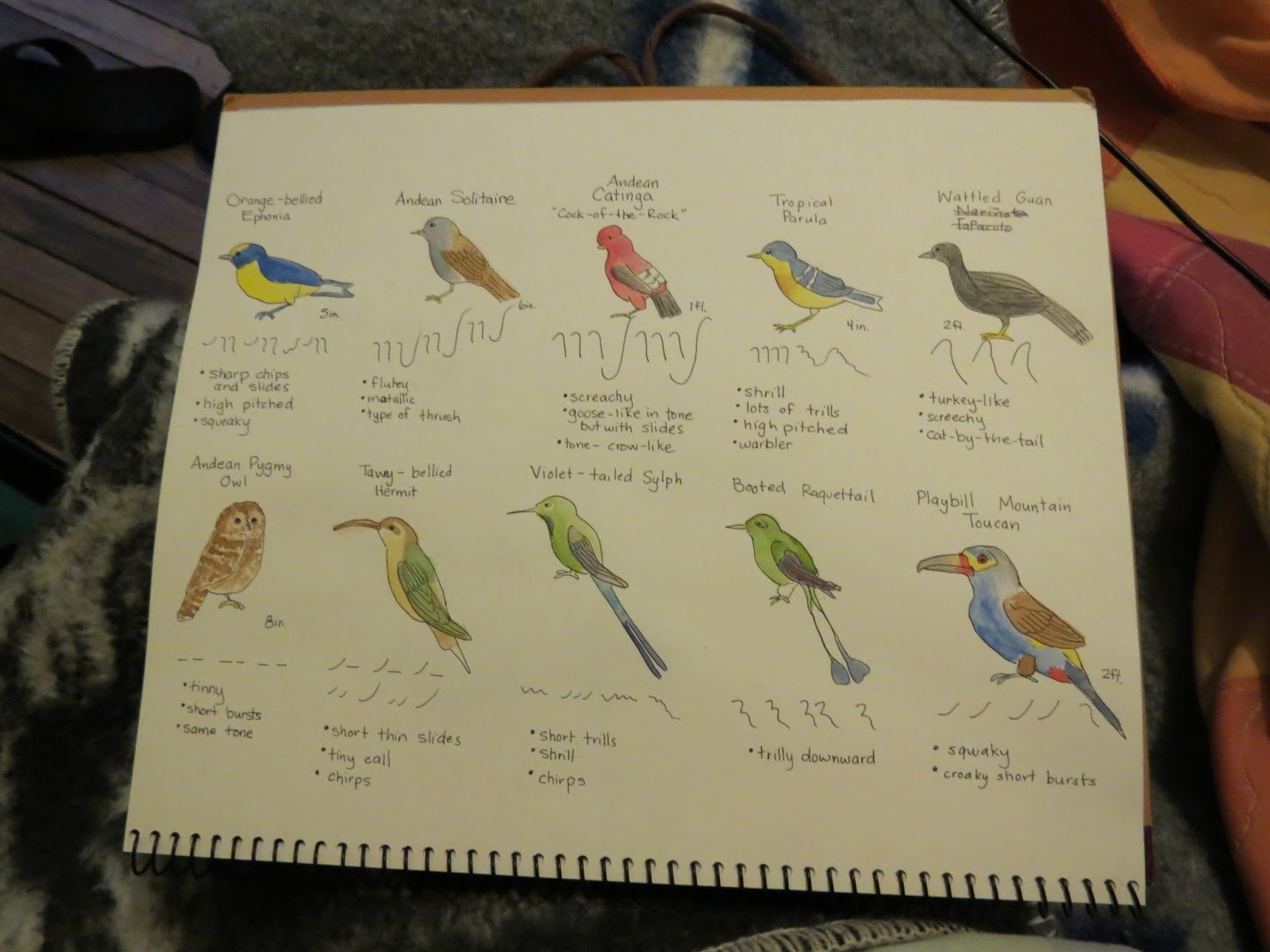
About 95% of what we recorded was heard calls, which, though great for learning calls, was not great for seeing birds.  Most birds, if seen, were fluttering by quickly, or far away.  So most of my ID skills came from looking in the bird guide.  It put a face with the call, as it were.  I started by own recording system to try to help me remember the bird and the sound of it's call.  In my notebook, I drew a small picture of the bird, did a quick semi-musical representation of their call, and wrote a short description.  The hope is that going back through my video clips, I will be able to pick out some familiar calls. 
 
 
 I tried to upload some of my video clips here for you, but unfortunately the files are just too large for this slow internet server.  Sorry!  But thanks to this amazing site I just found: www.xeno-canto.org, I can share some of the sounds with you!  Here are some of my favorite calls from the mountains.  (If you click on the name of the bird, it will take you to a page about the bird, and clicking my description will link you to a wav file). 
  
Even when we were not out on a bird survey, there was still a lot of action from our fine feathered friends.  In fact, right in front of the lodge are three feeders being used for research on hummingbirds.  If we had a spare minute, we often spent it watching the drama at the feeders.  It was my first time seeing hummingbirds in person, so I was captivated by their jerky, quick movements, their iridescence in the sunlight, and the thudding sound of their wings that always sounded like a bumble bee stick in a megaphone.


This little guy quickly became my favorite.  He is called a Booted Raquettail.  Can you guess why?  The female is similar, and has the same white little booties, but not the long tail.  Their call was only one that we recorded frequently.


On our long hike back from a bird survey, we were caught by the call of this White-Rumped Hawk.  It took us a minute to find him/her, perched at the top of this old, broken tree.  His/her call was unmistakably a hawk.

 My favorite bird adventure, though, was when we went to the Andean Cock-of-the-Rock Lek.  We left the lodge early so that we were there well before dawn, adding more warm clothes to combat the encroaching cold as we cooled down after the hike.  Gradually, as the sun rose, with it came the growing cacophony of calls from these unusual birds.  In fact, the first time we heard it, it was such a peculiar sound (something like a mix between the screech of an owl and the squeal of a pig), that I burst out laughing, fighting to muffle it in the collar of my jacket.  For about 40 minutes it was mostly just sounds that we heard, as all the flamboyant males competed for females' attention.  Eventually, though, some made there way up into the trees where we could finally get a good view.  Very well worth the wait!


I know that my blurry pictures and some sound-bites can't really capture exactly what it's like to listen as the forest wakes up, but I hope it at least helps you imagine it a little bit better!  I will keep trying to find a way to post some of the video clips, because they really bring it all together!

Saturday, August 3, 2013

Eco-tourism at its Best: Santa Lucia, Ecuador

For years now I have been traveling “ecotouristically” (that should be a word if it isn't).  With increasing pressures placed on the natural environment, I look for organizations that utilize natural wonders to attract tourists, and are therefore invested in protecting them.  Whenever possible, I try to find programs that are local.  By that, I mean that the organization was founded and is run by people from that country. When an organization or program is based internationally, programs cost more and all that money is then taken out of the country.  When it is local, any money you pay for the program is given back to the community to support the economy, providing jobs, and increasing the sense of ownership over natural resources by the local people.

I have participated in at least half a dozen programs by now, so I am starting to get a pretty good sense of how it works.  That being said, I just got back from the best model of ecotourism that I have seen so far.   I wanted to share a little bit about how their model works, in the hopes that you might either: have other models that you would like to share, be inspired to visit this place yourself, or that perhaps the right person reads this and the idea could start to create similar models elsewhere.

To start with, the program I would like to applaud is called Santa Lucia, which is a land cooperative, protecting 1800 acres of cloud forest in the Ecuadorian Andes.  Although their vision and mission have changed since then, the group started back in 1976, when a new reform act made land purchase more affordable to local people.  A group of 20 families pooled their resources and purchased what is now Santa Lucia. 
 
 
Over the years a variety of business options have been tried, including banana plantations, cattle farming, and medicinal remedies, finally settling on ecotourism in the 1990s.  The reserve has built a variety of accommodations (dormitories, private rooms and cabanas), playing host to tourists, volunteers, birders, outdoor enthusiasts, and people who are generally just looking "to get away from it all." 

It is probably here that I should elaborate....  in Santa Lucia, you are literally away from it all.  The nearest town is a 30 minute drive and an hour hike away.  There is a lovely main lodge, but the only way to get to it is to climb up.  1900 meters to be exact (Americans: that means roughly 5700 feet).  In order to preserve the pristine quality of the reserve, no roads lead to the lodge, only a series of trails.  It's a hike that the locals do (taking the steeper mule trail) in about a half an hour, but most of us visitors huffed and puffed our way up between 1-2 hours. 


Sendero Principal= Main Trail


An average trail.  Steep climbs, and light topsoil covering slippery clay underneath (as a nice brown bruise on my right forearm will prove)

I was surprised that I managed to make it up in just over an hour, though as the air got thinner and the trails got steeper, my breaks  and my nagging suspicion that I might breathe myself into oblivion got more frequent.  About 40 minutes in I had to start rooting for myself like a high-school basketball coach.  It worked.  I made it.  And this was the view I was rewarded with.


The vision of the cooperative is: “To run a well-organized ecotourism business that creates jobs and benefits for the community and which respects that values of the members of the cooperative and the community, permitting us to conserve the forest for the future."   This comes through loud and clear.  It is a warm, welcoming and interesting place to be.


In addition to the main lodge, on the property there is also a front porch area for relaxing,


The cozy front porch.  These hammocks were a favorite by the volunteers after a long day hiking.

private cabanas,


Our cabana:  Cabana de la Puma
an organic garden which supplies most of the veggies and herbs used by the kitchen,


Organic garden with cabbage, carrots, radishes, broccoli raab, lemongrass, mint, lettuce, spinach, and more!

outdoor showers and composting toilets. 


The composting toilets, urinals and outdoor showers.


My favorite shower was the corner one, because you had only two walls, and the rest is clouds.

As a guest of lodge, you get the chance to be remote, ensconced in an absolutely picturesque place, surrounded by “400 species of birds; 45 species of mammals including pumas and the endangered Spectacled Bear; and thousands of tropical plants, native to the region, including an amazing variety of orchids, bromeliads, and other epiphytes.”   Local guides can take you to see the bird and plant species, walk you to the waterfalls, and explain the history of the project. 

My time at the lodge was spent volunteering on a number of conservation initiatives they have there, which I will go into in later blog posts.  When we weren't working, the days are very quiet, without electricity internet or phone to get in the way.  Time is passed studying local species guides, playing cards, laughing, using candles once the sun sets.  It was serene and refreshing.


Me and my colleagues studying birds to help with bird identifications the next day.


We had a big family-style dinner on the last night, which was a great send off.
 
One of my favorite parts of the Santa Lucia Lodge was getting to know the people that worked there.  The whole reserve runs with only about 10 active workers.  There is a maintenance man, a housekeeper, administration, 3 lovely young ladies in the kitchen that pump out hearty and healthy meals three times a day, and guides and naturalists to help you know what you are looking at as you go exploring.  I was impressed with their dedication to this project.  The pressures on this ecosystem continue to increase, and maintain a place a remote as this takes a lot of hard work.


Guests pitching in to help get dinner on the table.

One of our favorite dinners from our stay at the lodge: stewed chicken, green beans, marinated cooked carrots and yucca patties with an herb sauce.  Yum!

Our favorite breakfast!  So much so that we asked for it again on our last day.  The main element is the banana leaf in the middle.  Kimbolitas.  They are individual little cakes wrapped in banana leaves and steamed.   

As our send off, some of the collaborative members played some Ecuadorian music for us, filling the lodge with energy, laughter and dancing.


All the people in residence during my stay at the lodge.  This includes the staff, 9 volunteers, 3 workers from another reserve who came to learn about Santa Lucia's model of ecotourism, and 2 field researchers conducting PhD research on hummingbird behavior.
 
 
Given the remoteness of the lodge, most workers stay on site, and others hike up and down every day.  Not only must the workers come and go, but so must all materials.  All the materials used to build, all the wood, the doors, the cement, all had to be carried either by hand or on muleback.  Delicate things like windows and glassware, as well as the heaviest items like the generator, had to be carried by people (the generator apparently took ten men all day to carry up to the site).  This continued commitment to their vision, for me, is what makes the difference at Santa Lucia.   Though there are lots of things they could do to make life easier or to make their lodge have more mass-market appeal, but no option is considered without weighing the costs.  Having a road to the top would be much easier, and would make bringing goods a simpler and faster task.  But at the cost of air quality, noise pollution and further forestation.  Not to mention the general sense of escape that would be lost if one can just come and go so easily. 


On our first night, the manager greeted us by saying "Welcome to Paradise."  Now after my sweaty and breath-deprived hike, I laughed a bit at the thought... but by the next morning, as I watched that night's clouds lifts and slide away, I realized I agreed with him.  This really was an idealistic place to spend a week.
But models like this are certainly not without their problems either.  As times continue to change, the cooperative is having a harder time keeping members.  Nowadays, a rugged hike up a mountain to work is not an attractive option.  From the original 20 founding families who invested in the purchase of land, only 12 members remain to carry on the vision.  Surrounding plots of land continue to be cleared, and hunters and loggers poach into the reserve grounds as the government has yet to invest in patrolling of protected forests.  But the remaining members are going strong.  They concentrate on the  continuous stream of happy guests passing through, the increasing spread of ecotourism, albeit slowly, and gains being made daily in the gathering of vital scientific data to further conservation efforts.
I keep those last positive things in mind the strongest.  For me, the Santa Lucia Reserve was a little slice of tranquility.  I have nothing but faith in the collaborative, and in their continued commitment to protecting what is one of the most ecologically significant ecosystems in the world.  And even if you are not a total nature nut like me, you have to admit that at the very least, it is absolutely gorgeous! 


Some of my favorite memories were of watching the changing views from our little oasis, seeing the clouds come and go, and the mist rise and fall.  I awoke to birds outside my window, and fell asleep to the sounds of crickets and frogs.  I could have happily passed two weeks at the lodge, drawing, painting, bird watching, reading, talking, laughing, and soaking it all in.  I hope you get the chance to see it for yourself!